
Laser Hair Removal by Skin Tone: What the Fitzpatrick Scale Means for You
If you have ever been told laser hair removal will not work on your skin, or worse, that it is not safe for you, there is a good chance you were given outdated information. Skin tone genuinely matters for laser hair removal. But the story has changed, and the old rules do not apply the way they used to.
Here is how skin tone affects your treatment, what the Fitzpatrick scale is, and why the right technology makes the difference.
First, How Laser Hair Removal Actually Works
To understand why skin tone matters, you need one key fact about how the laser finds hair.
The laser targets melanin, the pigment that gives color to your hair. When the laser fires, the pigment in the hair absorbs that light, turns it into heat, and that heat damages the follicle enough to slow or stop future growth.
This is why the treatment has always worked best on dark hair. Dark hair is full of the melanin the laser is hunting for. Very light blonde, red, gray, and white hairs have little or no melanin, so the laser has a hard time seeing them, no matter your skin tone.
Now here is the complication. Melanin is also what gives your skin its color. So on darker skin, the laser can get confused. The pigment in your skin competes with the pigment in your hair for the laser's attention. If too much energy gets absorbed by the skin instead of the follicle, the result can be burns or changes in skin color. That is the real reason skin tone matters, and it is exactly the problem modern lasers were built to solve.
What Is the Fitzpatrick Scale?
Dermatologists use a simple system to classify skin tone and how it reacts to light. It is called the Fitzpatrick scale, and it runs from Type I to Type VI.
Type I: Very fair skin, often with light eyes and hair. Always burns, never tans.
Type II: Fair skin. Burns easily, tans a little.
Type III: Light to medium skin. Sometimes burns, tans gradually.
Type IV: Olive or light brown skin. Rarely burns, tans easily.
Type V: Brown skin. Very rarely burns, tans darkly.
Type VI: Deeply pigmented dark brown to black skin. Almost never burns.
Your type is not about ethnicity or how much sun you get. It is about how much melanin your skin naturally holds and how it responds to light. Knowing your type helps a provider choose the right laser and the right settings for you.
Why Skin Tone Changes the Approach
The lower the contrast between your hair and your skin, the more careful the treatment has to be. There are three broad situations.
Lighter skin with dark hair (Types I to III). This is the easiest case for a laser. There is high contrast, so the laser can clearly tell hair from skin. Results tend to come quickly.
Medium and olive skin (Type IV). Still very treatable, but the settings need more care. The right wavelength and good cooling keep it both safe and effective.
Darker skin (Types V and VI). This is where the old machines caused problems, and where technology matters most. There is little contrast between hair and skin, so the wrong laser carries a real risk of burns or pigment changes. The right laser makes it safe.
The important message: every skin type on this scale can be treated today. The key is matching the tool to the tone.
The Technology Is What Changed
Older lasers used a single wavelength of light. Some wavelengths are absorbed heavily by melanin, which makes them fast and effective on light skin but risky on dark skin.
Here is the basic science, kept simple. Shorter wavelengths, like the 755 nanometer alexandrite, are strongly drawn to melanin. Great for light skin with dark hair, riskier as skin gets darker. Longer wavelengths, like the 1064 nanometer Nd:YAG, mostly bypass the pigment in your skin's surface and reach the follicle underneath. That makes the longer wavelength the safest choice for darker skin, because it targets the hair without overheating the skin.
For years, that meant your skin tone limited which machine could treat you, and many clinics only had one. Newer systems fixed that by combining wavelengths, so a single device can be tuned to your skin instead of forcing a compromise.
What This Means at Lux
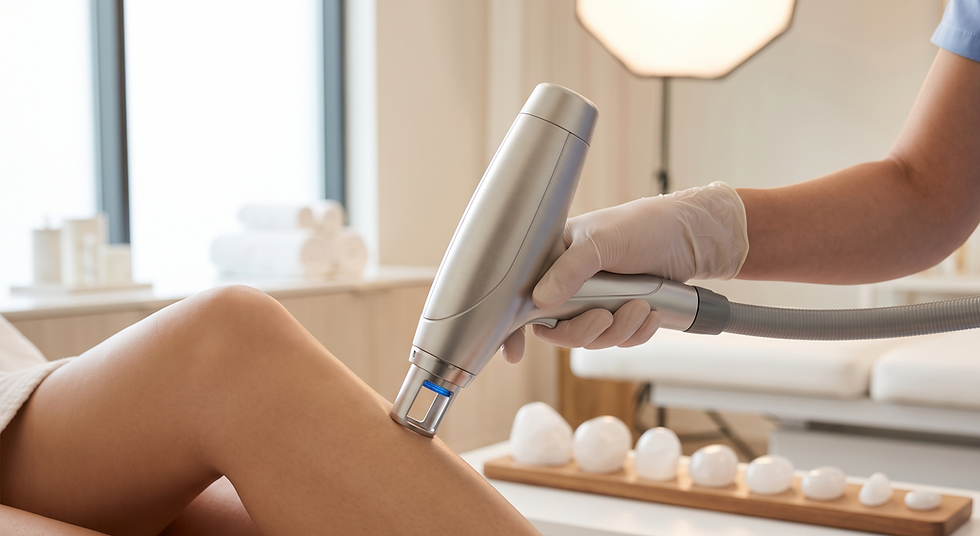
The device we use, the Alma Soprano Titanium, was built for exactly this problem. Rather than relying on one wavelength, it fires three at once: the 755 nanometer alexandrite, the 810 nanometer diode, and the 1064 nanometer Nd:YAG, together in every pulse.
That blend is what lets it treat the full range of skin types, Type I through Type VI, safely. The alexandrite brings efficiency for lighter skin, while the Nd:YAG brings the safety that darker skin needs, and the diode covers the middle. It also uses a gradual, in-motion heating style with cooling built in, which most people find far more comfortable than the sharp snap of older lasers.
In plain terms, you are not forced to hope your skin tone fits the one machine on hand. The technology adjusts to you.
Getting Ready, Whatever Your Skin Tone
A few things apply across the board, and they matter more the darker your skin is.
Avoid tanning before treatment. A fresh tan adds melanin to your skin and raises the risk of a reaction, even on lighter skin types. Sun exposure and self-tanner should be avoided in the weeks before a session. If you want the full reasoning on timing, our post on the best time to start laser hair removal covers it.
Expect a test spot. For darker skin especially, a good provider often treats a small test area first to confirm your skin responds well before doing a full session. This is a sign of care, not caution for its own sake.
Plan on a series. Hair grows in cycles, and the laser only affects hairs in an active growth phase. Everyone needs several sessions spaced weeks apart, regardless of skin tone, to catch each hair at the right time.
The Bottom Line
Skin tone matters for laser hair removal, but it is no longer a barrier. The old idea that darker skin cannot be treated safely belongs to an earlier generation of machines. With the right wavelength, the right settings, and a careful provider, every Fitzpatrick type can be treated well.
The real question is not whether your skin can be treated. It is whether the clinic you choose has the right technology and the training to use it for your skin.
At Lux, our laser hair removal is built around treating a wide range of skin tones safely, starting with a look at your skin type and hair before anything else.
Not sure if laser hair removal is right for your skin? Reach out to our team and we will give you an honest answer.



Comments